The Ballerinas Who Shaped The Nutcracker’s Heroine
Karyna Shatkovskaya has danced enough to know how a stage works. That, she says, is the complication. “For me, the most difficult part of Clara is probably the childlike excitement,” she says. “As a mature and experienced ballerina, I understand the stage, I understand how emotions work, and I know how to create a moment for the audience. But Clara doesn’t know any of that. Everything is happening to her for the very first time. So I have to find that very honest, spontaneous feeling of being a child again—not pretending to be excited, but actually allowing myself to be surprised.” Shatkovskaya dances Clara in NUTCRACKER! Magical Christmas Ballet. The problem she describes is particular to the role, and ballerinas have been solving it in different ways for over a century.
A Different Kind of Heroine
Clara occupies a distinct place within the classical canon. Consider the heroines audiences traditionally associate with great ballerina roles: Odette (Swan Lake) is a queen transformed by a curse. Aurora (The Sleeping Beauty) is a princess destined for a magical awakening. Giselle is a young woman whose love and betrayal lead her beyond the grave. Kitri enters Don Quixote already confident, spirited, and fully formed. “What I also love about Clara is that she isn’t introduced as a fully formed heroine with a dramatic story behind her,” Shatkovskaya says. “She is simply a young girl who has an extraordinary night. And I think that makes the role very personal, because we can all remember what it felt like to be a child and experience something magical, frightening or completely new for the first time.” The role asks for acting as much as technique. The ballerina has to move from childhood excitement through fear and into wonder, and arrive somewhere different than she started without ever losing the character’s essential nature—imagination without exaggeration, innocence without naivety. Even her name is unsettled. In E.T.A. Hoffmann’s 1816 story The Nutcracker and the Mouse King, the heroine is Marie; Clärchen—a diminutive of Clara—is the name of her doll. Most productions today call her Clara, but New York City Ballet keeps Hoffmann’s Marie, and Russian companies use Masha, the diminutive of Marie. Hoffmann’s original is also darker and stranger than the ballet. It is a psychological fairy tale filled with dreams, fears, and the space between childhood and adulthood, with a lengthy embedded backstory—”The Fairytale of the Hard Nut”—in which the mouse queen Madam Mouserinks transforms Princess Pirlipat into a grotesque creature, and Drosselmeier’s nephew, having broken the curse, is turned into a nutcracker himself. Marie’s parents refuse to believe her account of the battle and forbid her from speaking of her dreams. It is Marie who ultimately breaks the spell, declaring her love for the nutcracker regardless of what he looks like. That has left room for a century of interpretations. Four of them changed the role.

Ekaterina Maximova: The Child at the Center of the Dream
A legendary ballerina of the Bolshoi Ballet, Ekaterina Maximova brought extraordinary theatrical sensitivity to the role in Yuri Grigorovich’s Bolshoi production, filmed with Maximova and Vladimir Vasiliev in the late 1970s. In that version she is Masha, and Grigorovich’s scenario centers on her dreams. What made Maximova’s Masha memorable was the sincerity of the portrayal. She did not present childhood as an idealized concept. Her Masha was curious and vulnerable, a young girl encountering something beyond anything she had known. Beneath that innocence was considerable depth. Maximova understood that the journey is about meeting something that changes how the character sees herself and the world around her. Her interpretation reflected a defining quality of the Bolshoi dramatic tradition: the belief that even the most fantastical stories must begin with believable human emotion.

Gelsey Kirkland: The Adolescent Dreamer
Where Maximova found the child, Gelsey Kirkland found the young woman. Half a century ago, Mikhail Baryshnikov staged The Nutcracker for American Ballet Theatre; it premiered in December 1976 with Marianna Tcherkassky as Clara. But it was Kirkland, in the performances and the television film that followed, whose interpretation proved the most influential. Rather than portraying Clara simply as a child, she presented her as an adolescent standing at the threshold between childhood and adulthood, and that reading changed how many audiences understood the role. Kirkland’s artistry was built around emotional intensity. Her Clara was delighted by the magical world, and also deeply affected by it. The journey through the Land of Sweets became a psychological awakening, a glimpse into something past childhood imagination. She balanced vulnerability with maturity, revealing a character already capable of profound feeling rather than a miniature ballerina waiting to become a heroine. Through Kirkland, Clara became the ballet’s emotional protagonist, a young woman who stepped into another version of herself in front of us.
Alina Cojocaru: The Poet of Wonder
“The Nutcracker, who was a doll, becomes a prince, and Clara experiences this incredible sense of wonder and almost a first love,” Shatkovskaya says. “I think the challenge is to move through all these emotions, excitement, fear, wonder and falling in love, without making any of them feel exaggerated or ‘acted.’ I want the audience to believe that Clara is experiencing everything for the very first time.” That is the line every Clara walks, and Alina Cojocaru walked it with unusual delicacy. She danced the role at The Royal Ballet in 2000, when she was nineteen. Innocence in this part can easily become sentimental; Cojocaru’s Clara felt spontaneous and alive, a person discovering her own character’s innocence rather than performing it. Her great gift has always been making vulnerability appear effortless and true. In Clara, that quality is exalted. She performs as if discovering the ballet for the first time, and because we experience the world through her eyes, it feels new to us as well.

Gillian Murphy: Clara as Principal
In 2010, Alexei Ratmansky created a new Nutcracker for American Ballet Theatre that built the question of who Clara is directly into the choreography. His production gives her two forms: the child who moves through the party scene and the battle with the mice, and Clara the Princess, who appears in Act II to dance the duet with her Nutcracker Prince. The production premiered at the Brooklyn Academy of Music on December 23, 2010, with Gillian Murphy creating the role of Clara the Princess opposite David Hallberg as the Nutcracker Prince—a principal ballerina cast in a part that is often handed to a student. Shatkovskaya knows that shift from the inside. “There is a beautiful transition within the role,” she says. “At the beginning, I have to find this very innocent, almost instinctive childlike quality. But later, when Clara becomes the princess, the experience changes completely. And one of my favorite parts to dance is the Pas de Deux, because this is where the fairy tale becomes real ballet. There is still magic and emotion, but suddenly you can see the technique, the musicality, the partnering and the professionalism of the dancers.”

Karyna Shatkovskaya: Clara in the Present Tense
Maximova, Kirkland, Cojocaru and Murphy are studied now on film and in archives. Shatkovskaya is doing the work this season, and her account of it is the one thing the record cannot supply: what the role feels like from inside. Fear, for instance, is not a thing she plays. “When the mice appear, I don’t want to simply show the audience that Clara is scared,” she says. “I want it to feel real—like she is genuinely a little girl who suddenly finds herself in a world that she cannot control.” And there is one collaborator every Clara has shared, across every generation and every production.”I don’t think I could ever get tired of dancing to it,” she says of Tchaikovsky’s score. “No matter how many times I perform the Pas de Deux, there is always something that happens inside me when that music begins. I still get chills. The music doesn’t simply accompany the choreography, it almost carries the emotion for you. When I walk on stage and hear those first notes, I immediately feel the character, the story, the love and the magic of that moment.” It is why the ballet renews itself every December, for the dancers as much as for the audience. “You can dance the same choreography many times, but the music makes each performance feel new,” she says. “You are not just dancing the steps. You are living inside the music, the character and the feeling of being completely in love.”
The Clara Who Remains
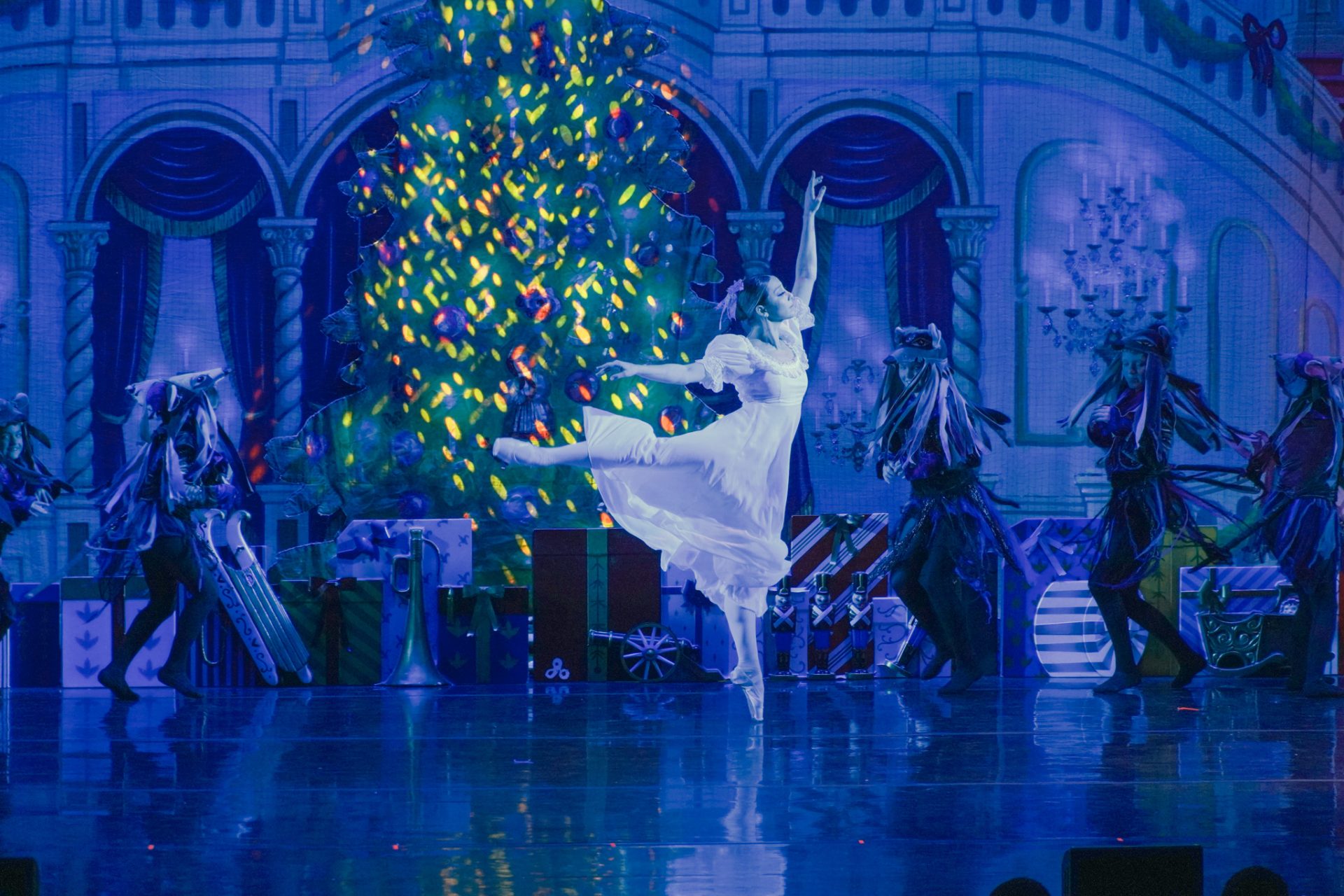
Onstage and in our imaginations, Clara is at once a child dreaming of another world and a young woman discovering herself. Each ballerina who has danced her revealed a different facet: Maximova the emotional clarity of childhood, Kirkland the awakening into herself, Cojocaru the wonder, Murphy the ballerina at the center of her own story. “I love that contrast,” Shatkovskaya says, “starting with a child who is simply overwhelmed by everything she sees, and ending with Clara as a young princess who has grown through this experience. For me, the Pas de Deux is where I can really show myself as a ballerina, while still keeping Clara’s emotional journey alive.” Clara’s real magic has always been about who she becomes in the course of the night. When she wakes and realizes it was a dream, something has changed in her, and by extension in us. Like a good many transforming childhood experiences, her travels are difficult to fully explain, but we know she is not the same at the end of them.
Join us to witness Clara’s magical inner and outer journey. NUTCRACKER! Magical Christmas Ballet is coming to a city near you. Maybe you’d like to be a part of the show? Auditions are coming up for ages 6–18 through our national Dance With Us partners.
Click below to sign up!